From the First Draft Friday podcast archives

Find Your Writing Flow: Proven Productivity Tips from Author Chris Fox
Have you ever experienced a true flow state as a writer? It’s that “in the zone” feeling when the words come effortlessly and scenes unfold faster than you can type. If that sounds unfamiliar, you’re not alone. Flow isn’t magic. It’s built through intentional habits and focused structure. When you develop it, you don’t just write faster. You become more productive in the moment and more prolific over time.
In this 2021 First Draft Friday authors chat, Alessandra Torre talked with science fiction and fantasy author Chris Fox about flow state and how to achieve it. He breaks down exactly what it takes to write more consistently, protect your creative focus, and build the systems that make flow easier to reach into these 5 customizable steps.
Be sure to check out the video and transcript of the full conversation between Alessandra and Chris embedded below.
How do you achieve flow state? (Updated for 2026)
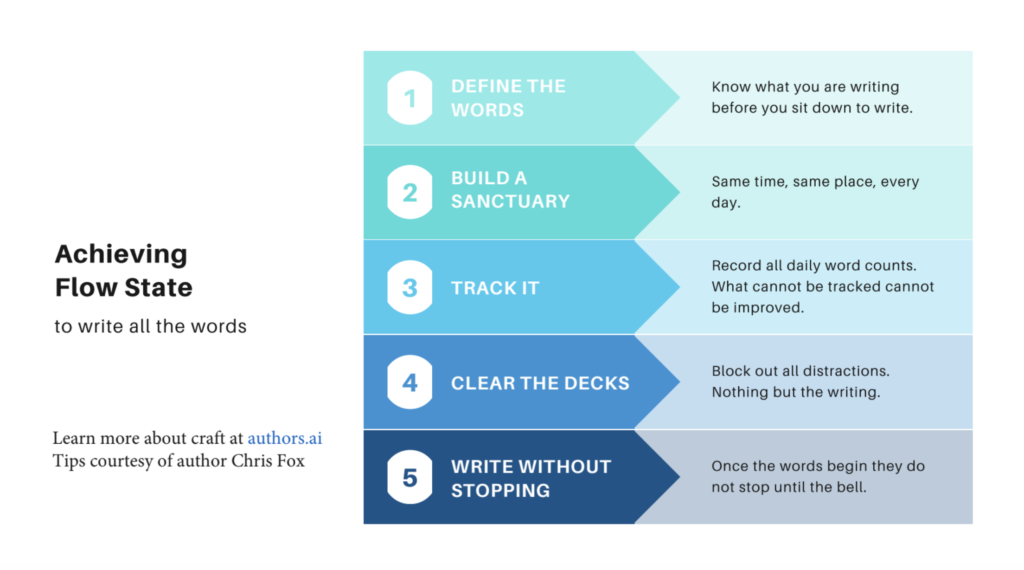
Step 1: Define your words (goal setting)

Before you can become prolific, you need to define what prolific means to you. Is it finishing a novel each year? Writing every day? Increasing your weekly word count?
Vague goals lead to vague results. Clear goals create direction.
Set a measurable target — whether that’s 500 words per day or three writing sessions per week — and track your progress. When you know what you’re aiming for, it becomes much easier to improve.
Step 2: Build a writing sanctuary

Writers thrive on routine. When you sit down in the same place at the same time each day, you train your brain to recognize that it’s time to write.
Your writing space doesn’t have to be perfect. It just needs to be consistent and free from distractions.
Even small rituals — a specific playlist, a cup of coffee, or a timer — can help signal that it’s time to focus. Over time, this consistency makes entering flow much easier.
Step 3: Track your words
If you want to become more productive, start tracking your output.
Recording your daily word count helps you see patterns, measure improvement, and stay accountable. It turns writing from a vague creative effort into something you can actively build.
Whether you use a spreadsheet, a calendar, a notebook, or a writing app, the key is consistency. When you measure your work, you’re more likely to stay committed to it. daily word count, you can improve it. Write down your number of words in a calendar or ledger each day to help trigger your brain’s competitive impulses.
Step 4: Clear the decks

Distractions are one of the biggest obstacles to productivity.
Before you begin writing, close unnecessary tabs, silence notifications, and eliminate anything that might interrupt your focus. Even small interruptions can break your momentum.
Protect your writing time. Treat it like an appointment that can’t be rescheduled.
Step 5: Just keep writing!
One of the most common productivity mistakes is editing while drafting.
When you stop to revise every sentence, you interrupt your creative flow. Draft first. Edit later.
Give yourself permission to write imperfectly. You can’t improve words that aren’t on the page.
The goal during your writing session is progress…not perfection.
Learn more about author craft at authors.ai/
Transcript (edited for better readability)
Increasing your writing speed— A Conversation with Chris Fox
(This podcast is no longer active, but we’re excited to share this archived conversation with Chris Fox.)
Introduction
Alessandra:
Hi everyone! I’m Alessandra Torre, and this is First Draft Friday, brought to you by Authors AI.
Today I’m joined by Chris Fox — science fiction and fantasy author — and we’re talking all about improving your writing speed. What does that really mean? And how can you do it without sacrificing quality?
Chris, I’d love for you to introduce yourself and tell us a little about your background.
Meet Chris Fox
Chris:
Hey everyone. I started out as a software engineer before publishing my first novel in October 2014.
Because of my tech background, I was really interested in the early intersections between publishing and AI — especially how Amazon’s algorithms and recommendation systems were evolving.
After some early marketing success with my novels, I started appearing on podcasts and eventually wrote a nonfiction series called Write Faster, Write Smarter. The first book was 5,000 Words Per Hour — a deliberately provocative title — and it took off. The series has now sold over 100,000 copies.
That said, my first love is epic fantasy and science fiction. I’ve published over 30 novels and around eight nonfiction books so far.
Why Write Faster?
Alessandra:
We have a great question to start us off. Why would someone want to write faster? Isn’t the creative process supposed to take time?
Chris:
That’s the number one concern I hear. People assume writing faster means rushing — and that rushing means sacrificing quality.
That’s not what I’m advocating.
When I talk about writing faster, I’m talking about getting into flow state as quickly as possible — where the mechanics fall away and you’re writing at your natural top speed.
There’s no fixed number you need to hit. I once topped out at around 3,000 words per hour, but beyond that it became uncomfortable. So I dialed it back.
The real goal isn’t speed for its own sake. It’s this:
If you want to turn all the ideas in your head into finished books — and possibly make a living doing it — you need to get more words on the page.
For me, I only had about an hour a day while commuting on a bus into San Francisco. I had a demanding tech job, a social life, and was dating the woman who is now my wife. Time was limited.
So I created a small oasis in my day.
Maybe you only have 12 minutes in the morning. But if you write 500 words in that window every day? That adds up fast over a year.
Writing faster doesn’t mean lowering quality. Craft is everything. But like a professional athlete, you practice slowly — and perform at speed.
The Five Steps to Writing Faster
Chris outlines a simple five-step framework for entering flow and increasing productivity.
Step 1: Define the Words
Before you sit down, know what you’re going to write.
You don’t have to outline heavily — even if you’re a pantser — but you should at least know:
- What scene you’re writing
- Who’s in it
- What’s happening
If you don’t, you risk staring at a blinking cursor.
Always sit down with intention.
Step 2: Build a Writing Sanctuary
Chris calls this creating boundaries of time and space.
Choose:
- A specific place
- A specific time
When you repeatedly write in the same environment, your brain begins to associate that space with writing.
It’s similar to how Steve Jobs wore the same outfit daily — reducing decision fatigue.
Your brain loves patterns. When you sit in that spot and put on your headphones, it knows what to do.
Your sanctuary could be:
- A home office
- A coffee shop
- A park bench
- Even a bus
Consistency is what matters.
Step 3: Track Your Word Count
This is simple — and powerful.
Write down your daily word count.
That’s it.
Over time, your brain naturally wants to improve. If you consistently see 1,000 words per day on a chart, you’ll start asking:
Why not 1,100?
Tracking builds momentum and accountability. It doesn’t need to be fancy — a notebook or calendar works.
Step 4: Clear the Desk
Before writing, eliminate distractions.
Chris’s ritual includes:
- Turning off Wi-Fi
- Closing email
- Closing games or extra tabs
- Opening Scrivener before anything else
He often opens his laptop to see only his manuscript — nothing else.
The goal is insulation.
If something major happens in the world while you’re writing? You’ll find out later. But in the meantime, your word count is protected.
Even a 20-minute timer can help. During that sprint, no internet.
Step 5: Write Without Stopping
Chris has softened his stance on this over time.
Originally: Don’t stop for anything.
Now: Do what works for your brain — but keep momentum.
If you don’t know a name? Insert XXX.
If research is needed? Leave a note.
Don’t derail your session to Google something for four hours.
Finish the scene first.
Writing Sprints and Daily Output
Chris typically writes in 20–30 minute sprints.
These days, he writes between 5,000–7,000 words in a two-hour morning session — including editing.
He writes first, then spot-edits the same day. The following morning, he rereads the last chapters to re-enter narrative flow.
He also edits in layers:
- Quick same-day edits
- Ongoing edits by his wife (who is also his editor)
- Final manuscript-level edit
The more books he writes, the less heavy revision is needed.
Dictation vs Typing
Chris is a big fan of dictation.
Average speaking speed: ~150 words per minute.
He used to dictate into his phone, then upload to Dragon NaturallySpeaking for transcription.
He would:
- Speak punctuation aloud
- Use placeholder names
- Replace them later
The learning curve is steep — but once mastered, it’s incredibly efficient.
Writing Under Time Pressure
One interesting observation:
Many writers are more productive when they have less time.
Chris found that when he went full-time, his output didn’t increase dramatically — he simply expanded tasks to fill the available time.
Deadlines create focus.
Short writing windows often produce more concentrated effort.
Editing Process
Chris edits quickly and decisively.
For shorter books (~60,000 words), he can complete a full edit in a single day.
He identifies major problems before sitting down and fixes them systematically from chapter one through the end.
He also allows flexibility in outlining — adjusting plot directions when better ideas emerge.
Where to Find Chris
Website: chrisfoxwrites.com
YouTube: youtube.com/chrisfoxwrites
He publishes:
- Epic fantasy and sci-fi
- Writing craft books
- Role-playing game materials
Closing
Alessandra:
Thank you so much for joining us. If this is your first time watching First Draft Friday, we’re here every other Friday discussing craft with authors and industry professionals.
This show is brought to you by Authors AI. If you haven’t tried Marlowe — our AI manuscript reviewer — visit authors.ai to learn more.
Happy writing, everyone. See you next time.