

Five steps science fiction author Chris Fox uses to write faster, focus deeper, and become a more prolific author

What flow state actually is
Flow isn’t magic. It’s that “in the zone” feeling when words come effortlessly and scenes unfold faster than you can type. Learning how to achieve flow state as a writer means building intentional habits and focused structure. When you develop it, you don’t just write faster. You become more productive in the moment and more prolific over time.
Science fiction and fantasy author Chris Fox knows this firsthand. A former software engineer turned novelist, he published his first novel in 2014. He later wrote the nonfiction series Write Faster, Write Smarter, including the breakout title 5,000 Words Per Hour. That series has sold over 100,000 copies. His framework for achieving flow comes down to five practical, customizable steps.
Why write faster at all?
The number one concern writers have is that faster means rushed, and rushed means lower quality. Chris pushes back on that directly. Writing faster isn’t about hitting a specific word count. It’s about getting into flow as quickly as possible, where the mechanics fall away, and you write at your natural top speed.
The real goal is simple. If you want to turn all the ideas in your head into finished books, you need more words on the page. Chris wrote his early novels during a one-hour bus commute into San Francisco. Time was limited. So he built a small oasis in his day. Even 12 focused minutes each morning can add up to something significant over a year.
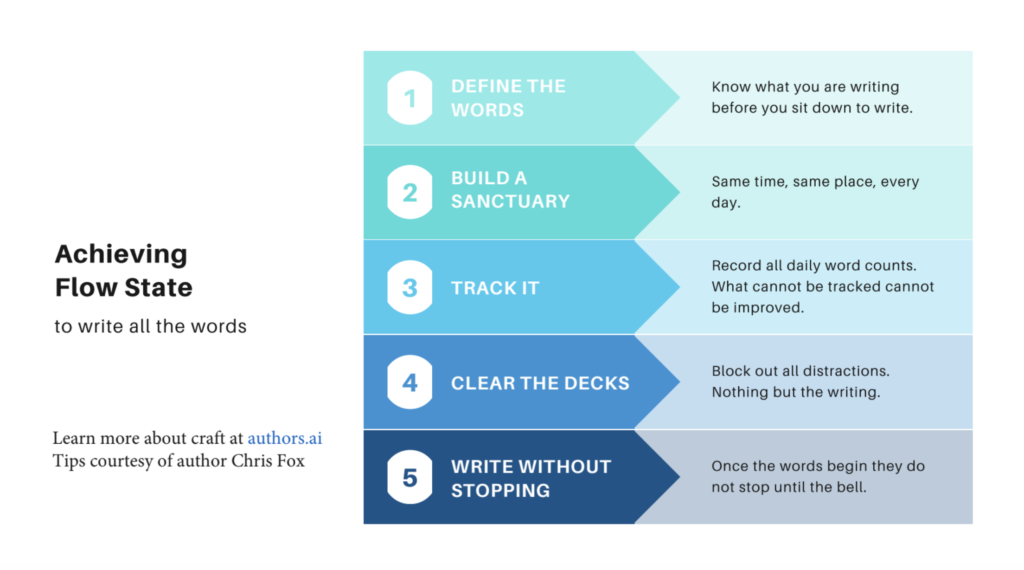
Step 1: Define your words
Before you can become prolific, you need to define what prolific means to you. Is it finishing a novel each year? Writing every day? Increasing your weekly word count? Vague goals lead to vague results. Clear goals create direction.
Set a measurable target. Whether that’s 500 words per day or three sessions per week, and track your progress. Just as importantly, know what you’re going to write before you sit down. You don’t need a heavy outline. But you should know what scene you’re writing, who’s in it, and what’s happening. Without that, you risk staring at a blinking cursor. Always sit down with intention.
Step 2: Build a writing sanctuary
Writers thrive on routine. When you sit down in the same place at the same time each day, your brain learns to associate that environment with writing. Your sanctuary could be a home office, a coffee shop, a park bench, or even a bus. Consistency is what matters…not perfection.
Small rituals reinforce the habit. A specific playlist, a cup of coffee, or a simple timer can all signal that it’s time to focus. Chris opens his manuscript before anything else and often turns off Wi-Fi entirely. The goal is insulation. Your word count deserves protection.

Step 3: Track your words
This step is simple — and surprisingly powerful. Write down your daily word count. That’s it. Over time, your brain naturally wants to improve. If you consistently see 1,000 words per day on a chart, you’ll start asking why not 1,100.
Tracking turns writing from a vague creative effort into something measurable. Whether you use a spreadsheet, a notebook, or a calendar, the key is consistency. When you measure your work, you’re more likely to stay committed to it.
Step 4: Clear the decks
Distractions are one of the biggest obstacles to flow. Before you begin writing, close unnecessary tabs, silence notifications, and eliminate anything that might break your momentum. Kids, pets, and devices top the list. Even a 20-minute focused sprint with no internet can protect your session.
Treat your writing time like an appointment that can’t be rescheduled. Something major might happen in the world while you’re writing. You’ll find out later. In the meantime, your word count stays intact.

Step 5: Just keep writing
One of the most common productivity mistakes is editing while drafting. When you stop to revise every sentence, you interrupt your creative flow. Draft first. Edit later. Give yourself permission to write imperfectly. You can’t improve words that aren’t on the page.
If you don’t know a character’s name, insert a placeholder. If research is needed, leave a note and keep moving. Don’t derail your session with a four-hour Google detour. Finish the scene first. The goal during your writing session is progress — not perfection.
Sprints, dictation, and editing layers
Chris typically writes in 20 to 30-minute sprints. During a two-hour morning session, he produces between 5,000 and 7,000 words. This includes editing. He writes first, then spot-edits the same day. The following morning, he rereads recent chapters to re-enter the narrative before continuing.
Dictation is another tool worth considering. The average speaking speed is around 150 words per minute. Chris dictated into his phone and uploaded recordings for transcription. The learning curve is steep. But once mastered, it’s remarkably efficient. The more books he writes, the less heavy revision he needs…craft sharpens with practice.

One surprising truth about productivity
Many writers are actually more productive when they have less time. Chris noticed that when he went full-time, his output didn’t increase dramatically. Tasks simply expanded to fill the available hours. Deadlines create focus. Short writing windows often produce more concentrated effort than wide-open days.
If you only have 30 minutes, use them. Don’t wait for a perfect stretch of uninterrupted time that may never come. Build the habit in whatever window you have — and protect it fiercely.
About the author
Chris Fox is a USA Today bestselling author of epic fantasy and science fiction, with over 30 novels and eight nonfiction books to his name. A former software engineer, Chris brings a systems-driven approach to the craft of writing. His Write Faster, Write Smarter nonfiction series — including the bestselling 5,000 Words Per Hour — has sold over 100,000 copies and helped thousands of writers build more productive, sustainable creative practices. You can find his novels, writing craft books, and role-playing game materials at chrisfoxwrites.com and his YouTube channel at youtube.com/chrisfoxwrites.
Editor’s Note: This blog post was written from a previous conversation between Alessandra Torre and Chris Fox.
Learn more about how Marlowe, our fiction-savvy non-generative A.I. analysis tool, can help with your productivity. Explore: authors.ai/


